
How to Choose an Air Fryer
Air fryers come in a wide range of sizes, designs and prices, and the right choice depends on how you plan to use one. A compact model can make sense for one person or a smaller kitchen, while larger or dual-basket models can be more useful for families or anyone who regularly cooks several foods at once. Before comparing individual models, it helps to understand which type of air fryer fits your needs, which features are actually useful, and how much you need to spend.

What should you consider before buying an air fryer?
Start with how you expect to use the air fryer rather than focusing on the number of features or the largest capacity you can afford. Think about:
-
- How many people you normally cook for. A smaller model may be sufficient for one or two people, while households cooking larger portions may benefit from more capacity.
- What you want to cook. If you mainly want to prepare fries, vegetables, chicken or other everyday foods, you may not need a model with a long list of specialized programs.
- How often you will use it. If the air fryer will become part of your daily cooking routine, convenience features and easy cleaning may matter more than they would for occasional use.
- How much food you want to cook at once. Basket capacity can make a noticeable difference when preparing meals for several people.
- How much you want to spend. There are compact and relatively simple models at lower prices, while larger models and those with additional functions can cost considerably more.
Once you have a clearer idea of how you will use the appliance, choosing between the different types becomes easier.
How big should your air fryer be?
Capacity is measured in quarts (qt). Brands measure it slightly differently, so treat these figures as a guide. If you’re between two sizes, choose the larger one, because food cooks better when air can circulate around it.
| Who you cook for | Capacity to look for | Type |
|---|---|---|
| 1 person, or small portions | 2–4 qt | Compact |
| 2 people | 4–6 qt | Standard single basket |
| 3–4 people | 6–8 qt | Standard single basket or dual basket |
| 5 or more people, or batch cooking | 8 qt and up, or dual baskets totalling 9–10 qt | Large or dual basket |
What type of air fryer do you need?
Air fryers are available in several different designs. The best option depends largely on the amount and type of food you normally prepare.


Compact and small air fryers
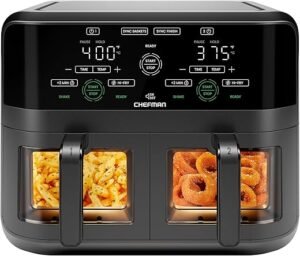
Small air fryers can be a practical choice for one person, smaller portions or kitchens where countertop space is limited. If you do not regularly cook large meals, paying more for a much larger basket may not provide much benefit.
Standard single-basket air fryers
A traditional single-basket air fryer is the simplest option and works well for many everyday cooking tasks. It can be a good middle ground if you want more capacity than a compact model without the additional size or complexity of a dual-basket design. For many households, a standard single-basket model is all that is needed.
Dual-basket air fryers
Dual-basket air fryers have two separate cooking compartments, allowing you to prepare different foods at the same time. Some models can also coordinate the cooking cycles so that both baskets finish together. This can be useful when you regularly prepare meals containing different foods that require different cooking settings or times.
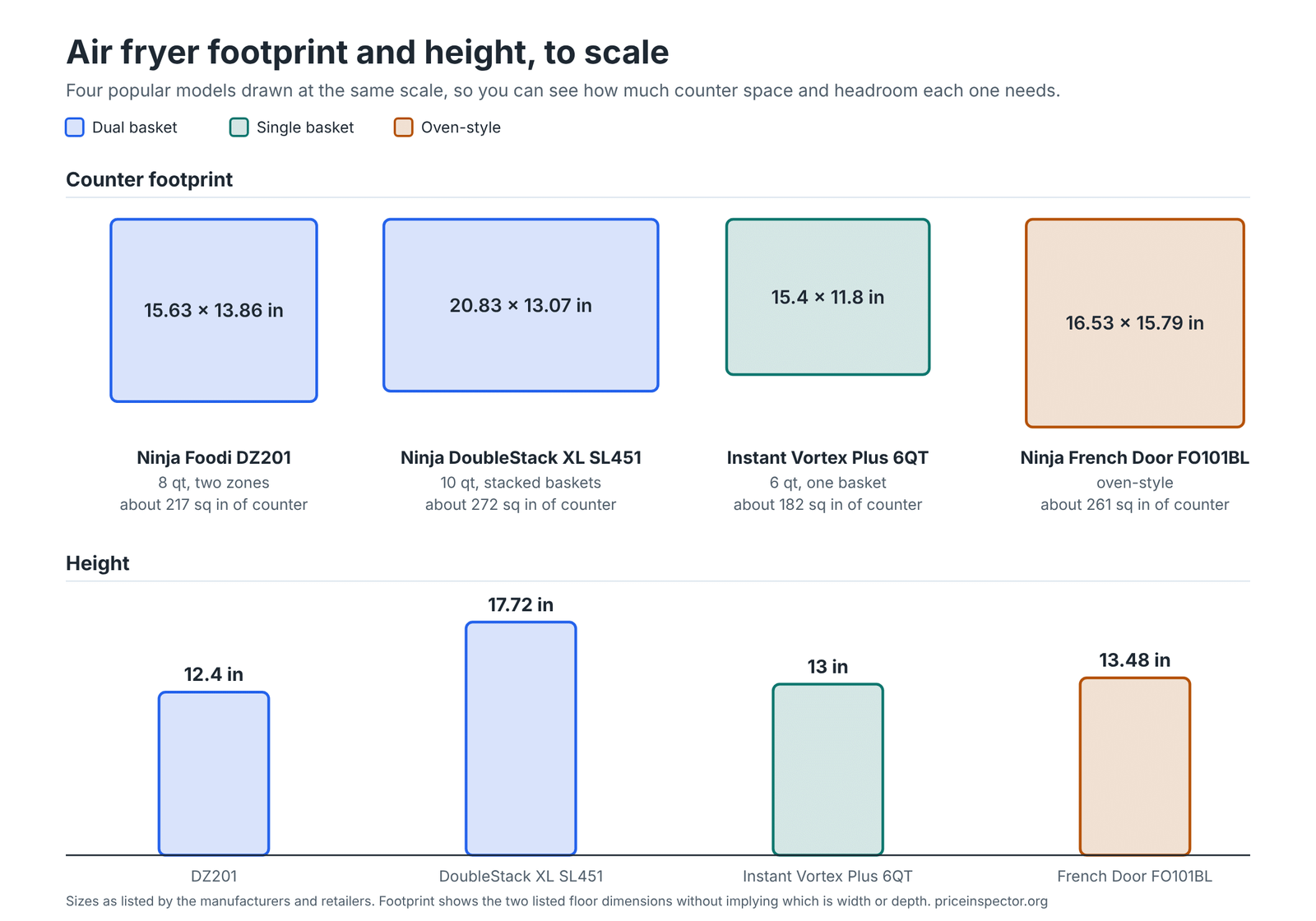
A dual basket isn’t right for everyone. If you usually cook for one or two people, mostly reheat leftovers, or have limited counter space, a single basket is simpler, takes up less room and is usually cheaper. A dual basket pays off when you cook for three or more, or regularly make a main and a side at the same time.
Larger and family-size models
Larger air fryers provide more cooking capacity and can be useful for households preparing bigger portions. However, larger capacity also generally means a larger appliance, so it is worth considering how often you will actually use the additional space. A larger basket is not automatically better if you normally prepare small portions.
Which features actually matter?
Air fryers can come with a surprisingly long list of features. Some can be useful, while others may have little impact on how you actually use the appliance.
Basket design and ease of cleaning
The basket is one of the parts you will handle most often, so its design matters. Look for a basket and cooking tray that are easy to remove and clean. If the manufacturer states that components are dishwasher-safe, that can also make regular use more convenient.
Temperature and time controls
Adjustable temperature and cooking time are basic but important features. Digital controls can make settings easier to adjust, while simple manual controls may be perfectly adequate if you prefer straightforward operation.
Preset cooking programs
Presets can make common cooking tasks easier by providing predefined settings. They can be convenient, but they are not necessarily essential. You can still adjust temperature and cooking time manually on many models.
Viewing windows
Some air fryers include a window that lets you check the food without opening the basket. This can be convenient, although it is not a feature everyone will consider necessary.
Sync or matching functions on dual-basket models
For dual-basket air fryers, functions that coordinate the two cooking compartments can be particularly useful. They can help when two foods have different cooking requirements but you want them to finish at roughly the same time. The important thing is to prioritize features you are actually likely to use rather than paying extra for a long specification list.
What does it cost to run?
Air fryers use roughly 1,200–1,800 watts. To estimate the cost of one cook:
wattage ÷ 1,000 × hours × your price per kWh
For example, a 1,500 W air fryer running 20 minutes uses about 0.5 kWh. At $0.17 per kWh, that’s about 8 cents. Use your own electricity rate. Because it preheats quickly and cooks in a small space, it often uses less energy than heating a full-size oven for the same meal.
Features worth having and the ones you can skip
Worth it: a dishwasher-safe basket, a shake reminder, a decent temperature range, a clear display.
Skip: a long list of presets (most people use two or three), and a big capacity you won’t fill.
How much should you spend?
There is no single price that makes an air fryer a good choice. The right budget depends on the capacity, design and features you need.
Lower-priced models can be suitable if you mainly want a simple appliance for smaller portions and everyday cooking. Moving into higher price ranges can give you larger capacity, dual baskets, additional controls or other convenience features.
Before paying more, consider whether the additional features solve a problem you actually have. If you mainly want to cook simple meals for one or two people, a compact model may make more sense than a large premium appliance. If you already know roughly how much you want to spend, comparing models within that range can make the choice much easier.
Quick guide: which air fryer is right for you?
2–4 qt compact
See small air fryers → Cooking for 2
4–6 qt single basket
See all air fryers → Family of 3–4
6–8 qt, or dual basket
See dual basket → 5+ people or batch cooking
8 qt and up, or dual 9–10 qt
See dual basket → Two foods at once
Dual basket with sync
See dual basket → Keeping it cheap
Start under $100
See under $100 →
Compare Air Fryer Prices
Once you know what type of air fryer and which features you need, it is worth comparing prices before buying. The same or similar air fryer can be offered at different prices by different retailers, and prices can change over time. Comparing current offers can help you see what is available within your budget rather than choosing a model based only on its advertised price.
Compare Air Fryers and Current Prices
Price Inspector lets you compare current air fryer offers from leading retailers and explore models by price, type and features. Prices and availability can change, so check the latest offer before you buy.